ZEN
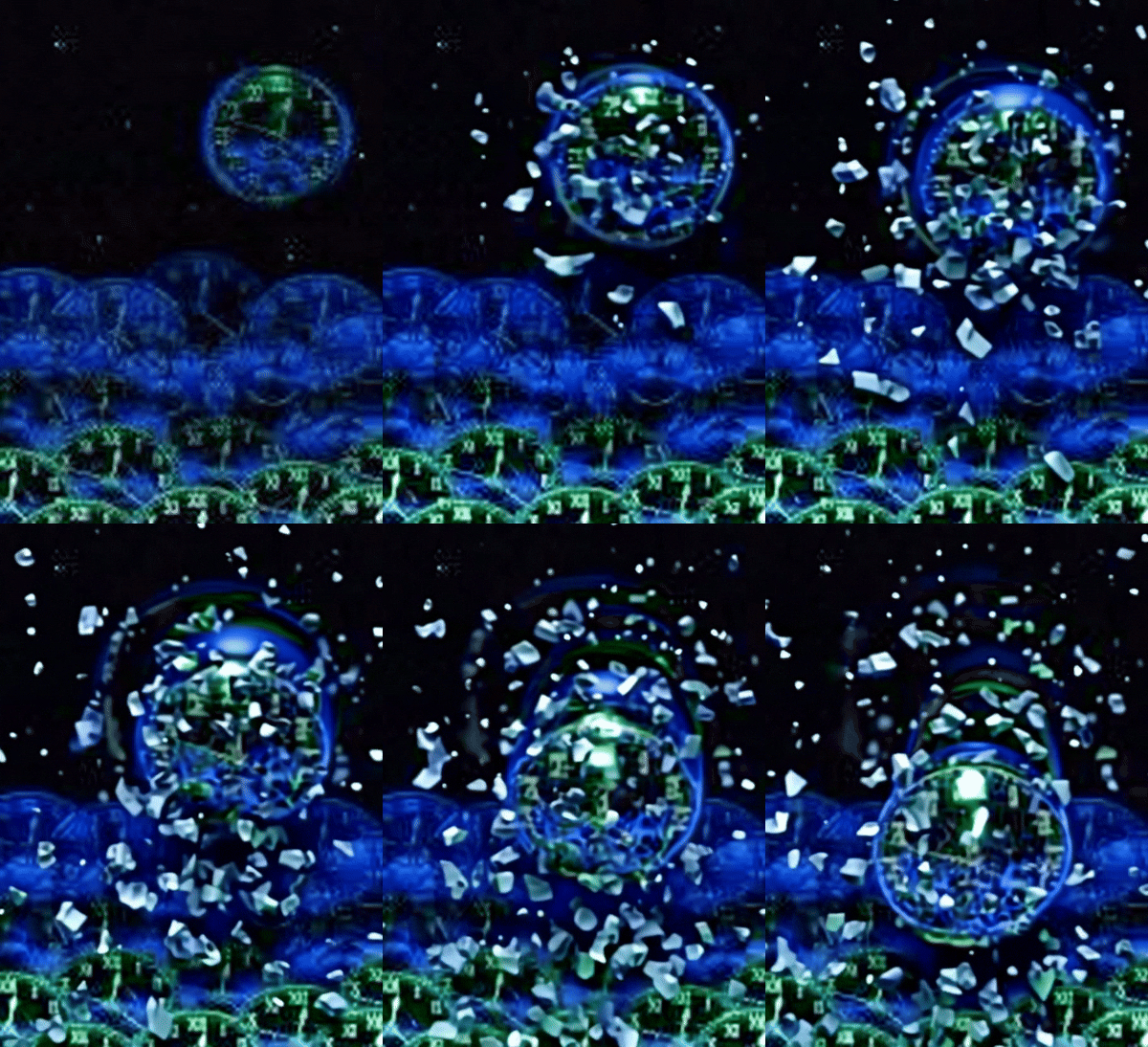
All life is fleeting. Yet existence is eternal.
When the essence of our being, our actual truth, enters the body in the form of a spirit being (Gandharva), that form of expression of our being, which we commonly call life, arises through birth. This journey is subject to certain generally valid rules in the material universe. A characteristic feature of our world is the transience of all life. All life on our level of experience begins with birth and ends with death. In our experience, this circumstance is immediately painful and finds manifold expression in this. Everything – really everything – life strives, changes, falls ill, ages and passes away – even if the fundamental immortality in eternity on a metaphysical level remains untouched by this. Consequently, we may not deny that expression of transience, but rather be aware that we can penetrate „reality“ by virtue of our spirit, to finally overcome it. Nirvana, as a symbol of constancy that is no longer subject to any kind of change, takes place, in my opinion, in the recognition of the inner centre and not through denial of the laws of the world. In every life there is on the one hand maturation (in the form of increased awareness) and on the other hand decay. In the recognition of these mechanisms, in the feeling of this „truth“ lies a motive of boundless serenity. A peaceful recognition of the mechanisms within our „reality“ forms the basis for overcoming them. This is generally achieved by trusting in the order of creation – which in turn is the cause of serenity. A further consequence of the contemplation of one’s own being embedded in the cosmos is a gradually varying degree of attentiveness in experiencing life on our level. So what might all this mean for us practically?

We may all recognize, serenely, peacefully and calmly, that our wanderings are components of a higher and more comprehensive order and thus derive immediate benefit for our daily experience. We may continue to realize that all life comes from a common source and this may lead us to patience and gentleness in dealing with each other. In recognizing these emotions we experience our inner peace and may we form ourselves into tolerant, friendly and benevolent beings. Through this, we usually have the opportunity to experience our being as cheerful and we can discover the joy of equanimous compassion. By recognizing our common origin, gratitude is formed in our conscious experience and feelings of anxiety, abandonment and loneliness are overcome. Even if we occasionally seem to leave the path of truth found for ourselves, our once made choice to master our being always leads us back to our once chosen path. That virtue of recognizing one’s own continuous change is, in my experience, more effective and insightful than merely following the moral concepts of our fathers (although these are usually justified). Peace is most likely to arise in us when we ask ourselves about the individual needs of our soul and then follow them.
To rest in one’s own inner center means to follow individual paths and to follow the personal recognized truth, even if it changes in the course of our journey. A practical path, which may be taken here, lies in the acknowledgement of one’s own transience. In the Buddhist teachings great importance is attached to the meditative examination of death. This exercise may be very valuable for awareness of impermanence, but it does not change the inevitable end of any life on this level.
Whether our experiences are more or less painful or peaceful depends largely on our attitude towards things. The spirit is the master of our being and it is up to us whether we want to grasp the finger points of fate and put them into practice. Being born, aging and dying are natural processes and conditions and a lived life is only one station on our eternal journey to infinity.
Aquarius. You only see what you know.